
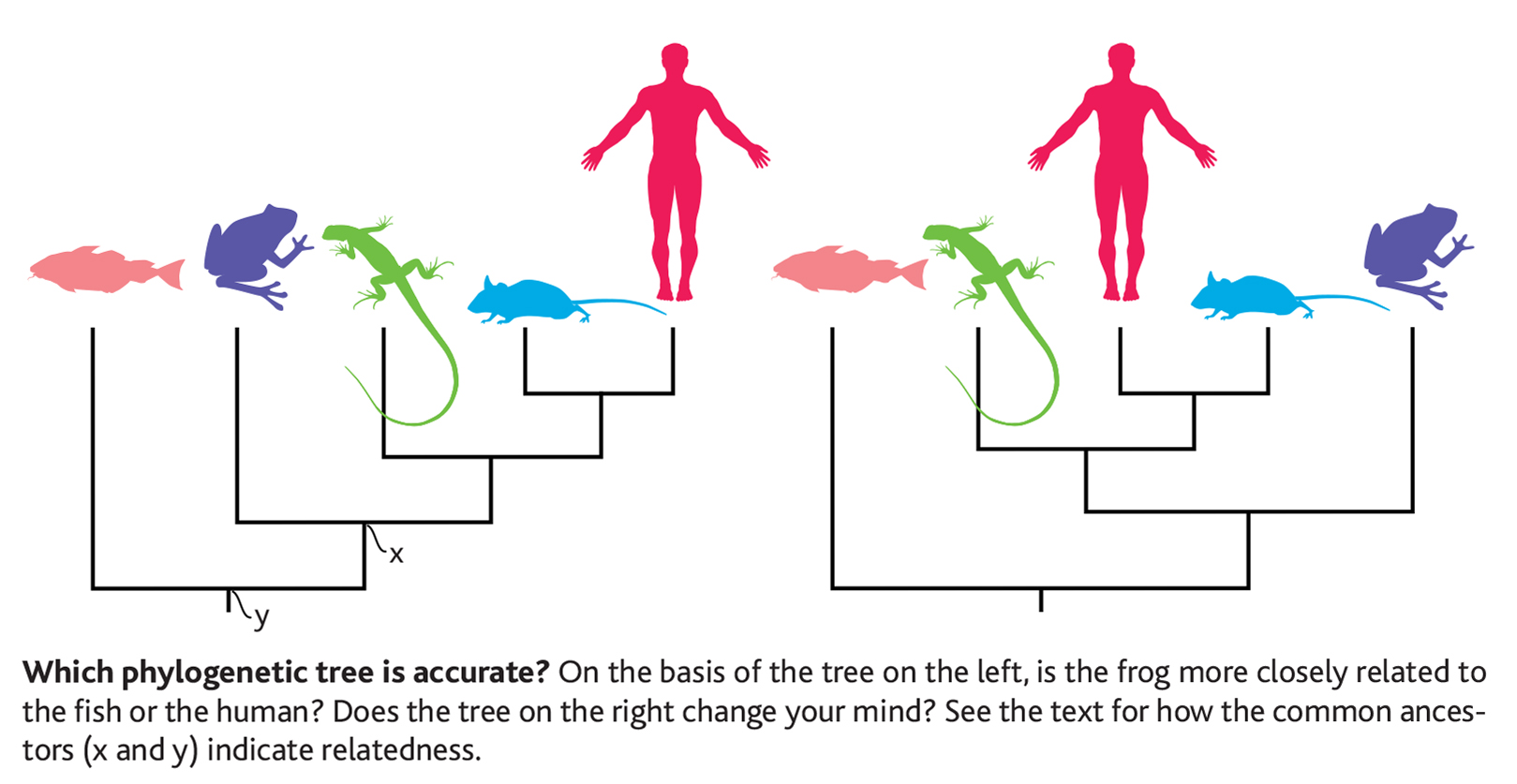
This diagram is from the paper “The tree-thinking challenge” by Baum, De Witt Smith, and Donovan, Science, vole 310, 11 November 2005, p. 979-980.
One aspect of phylogeny highlighted by this figure is that the branches of a tree can be rotated at a node without changing the proposed evolutionary relationships of the organisms. A common misconception is that phylogenetic trees can be read from their tips. The correct way to read a tree is to focus on the sets of nested groups and note their hierarchy, which represents the relationships among the organisms.
Consider another example. In the diagram below, what is the relationship between taxa A, B, C, and D?
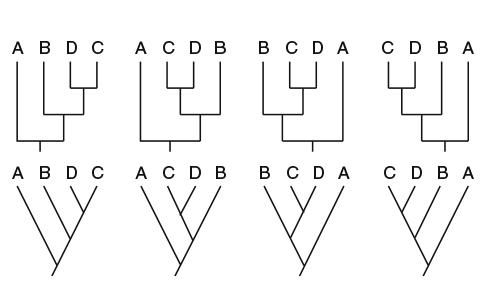
Figure 1. Source: “Teaching tree-thinking to undergraduate biology students,”
by Meisel, 2010, Evolution Education Outreach, vol. 3, p. 621-628.
Phylogenetic tree basics.
- A phylogeny represents the evolutionary relationships among a species or group of taxa.
- Taxa refers to a group of organisms. Taxon may refer to a clade, a species, a genus, or other taxonomic group. Taxon is singular for taxa.
- The tips of trees represent the descendants of a group of taxa.
- The nodes represent common ancestors of two or more taxa.
- Sister groups are two taxa that are descended from the same common ancestor.
- One goal of determining a phylogeny is to be able to trace the descendants back to a common ancestor. If the tree includes all descendants of the common ancestor, it is said to be monophyletic.
- synapomorphy – derived characteristics that make a group unique from other, closely related groups
- plesiomorphy – ancestral trait shared by two or more taxa
Now, let’s consider a phylogeny among vertebrates and protochordates; a chance to practice our tree thinking skills.
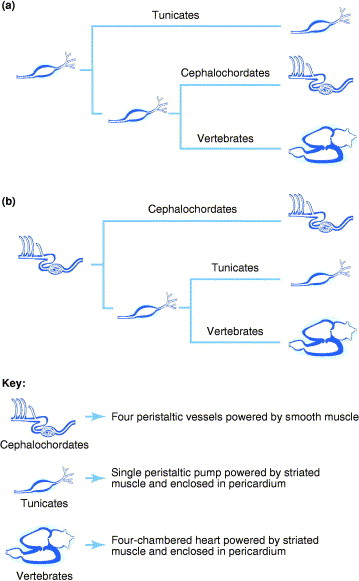
Figure 1. Phylogenies of chordate heart evolution.
“Amphioxus and tunicates, evolutionary model systems,” by Schubert, Escriva, Xaveri-Neto and Laudet, 2006, Trends in Ecology and Evolution, vol. 21, no. 5, p. 225-277.
Tunicates have a single, peristaltic pump. Compare this heart to the four peristaltic vessels of the cephalochordates.
- Is the single peristaltic pump an ancestral or derived trait based on phylogeny a?
- Is the single peristaltic pump an ancestral or derived trait based on phylogeny b?
- Explain how and why the answer differs for each phylogeny.
- Which phylogeny correctly represents the evolutionary relationships among vertebrates and the two protochordates (sea squirts, cephalochordates)?
