
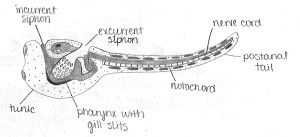
The larval stage of the sea squirt exhibits all five of the chordate characteristics, features common to all vertebrates.
Because the sea squirt is a chordate and soft bodied, it makes an excellent organism for the study of vertebrate ancestors.
The sea squirt, or tunicate, is a chordate that is argued to be the closest living relative to the chordate group, vertebrates. The sea squirt is classified as Phylum Chordata, Subphylum Urochordata. The subphylum name comes from the fact that the notochord is found in the tail of the larval stage. In its larval stage, the sea squirt contains all 5 characteristics of chordates: a postanal tail, dorsal hollow nerve cord, a notochord, pharyngeal slits and an endostyle. As it matures into its adult stage, all of these characteristics disappear except for the pharyngeal slits and the endostyle.
Sea squirts are often referred to as “protochordates” which suggests they have features one might find in an ancestral chordate and/or an early vertebrate ancestor. A study of sea squirts may provide clues about early vertebrate anatomy and physiology.
